Skip to content
Let’s talk
Back to Insights

Guides

AI Automation Costs UK: Pilots, Implementation Ranges, Retainers, and Quote Red Flags

AI automation costs UK guide for SMEs comparing quotes: pilot budgets, implementation ranges, support retainers, hidden costs, quote warning signs, and ROI checks.

AI Automation Costs UK: Pilots, Implementation Ranges, Retainers, and Quote Red Flags

If you are searching for AI automation pricing in the UK, you probably want a straight answer before booking a call. This guide uses illustrative implementation budgets to explain cost drivers. These examples are not current Elevate AI prices: paid consulting and any subsequent implementation are scoped separately.

Elevate AI prices consulting around the agreed scope and deliverables, with implementation quoted separately. The managed Outbound Sales Engine has an initial configuration fee and an ongoing monthly service fee. It has a binding initial three-month minimum commitment; service details are set out in the proposal. See how our pricing works; the budget examples in this article are not a current Elevate AI rate card.

Related reading: Impact Chauffeurs case study.

AI automation pricing UK: quick budget guide

If you only need the short version, most UK SMEs should budget in four layers: discovery, a focused pilot, any wider implementation, then support. The safest first step is usually a paid pilot that proves one real workflow before you commit to a larger build.

Engagement type Typical UK SME budget Best for What to check before buying
Workflow audit Free to £1,500 Prioritising opportunities before build Does it produce a clear ranked roadmap?
Focused pilot £3,000 to £5,000 plus VAT Testing one measurable workflow Are success metrics agreed before build?
Simple workflow automation £5,000 to £10,000 plus VAT Replacing one manual process with approvals, alerts, and reporting Are exceptions and handover steps documented?
Multi-system implementation £10,000 to £25,000 plus VAT Connecting CRM, email, forms, documents, finance, or operations tools Are testing, training, and documentation included?
Support retainer £350 to £1,500 plus VAT per month Monitoring, optimisation, and safe scaling Can you pause or cancel without lock-in?

The ranges above are illustrative planning examples for implementation work, not fixed market rates or an Elevate AI price list. Validate scope and current supplier quotes before budgeting.

What should you expect at each budget level?

A good AI automation quote should make it obvious what you are buying, what is excluded, and how success will be measured. If the proposal only says "AI transformation" or "automation setup" without naming the workflow, systems, approvals, and support model, push for more detail before approving spend.

At £3,000 to £5,000, expect a focused pilot on one workflow: for example CRM follow-up, enquiry triage, reporting, onboarding admin, or document handling. The output should be a working version, a measured baseline, clear handover notes, and a decision on whether to scale.

At £10,000 to £25,000, expect a broader implementation that connects multiple systems, handles exceptions, includes testing and training, and gives the team confidence to use the workflow after launch. This is where CRM, email, forms, documents, dashboards, and human approvals often come together.

On monthly support, expect monitoring, fixes, optimisation, and small improvements as the business changes. Support should be clear enough that you know response times, what is included, and whether you can cancel without a long lock-in.

What does AI automation consultancy cost in the UK?

For most UK SMEs, the realistic range looks like this:

Pilot projects: £3,000 to £5,000 plus VAT. A pilot targets one specific workflow, proves the concept on a live process, and gives you measurable results within two to six weeks. This is where most sensible engagements start.

Full implementations: £10,000 to £25,000 plus VAT. These cover multiple processes, deeper integrations, and more complex logic. A typical full project runs 8 to 12 weeks from discovery to deployment, including training and documentation.

Monthly retainers: £350 to £1,500 plus VAT per month. Retainers cover monitoring, maintenance, optimisation, and priority support. The cost depends on how many automations are running and how much ongoing change is needed.

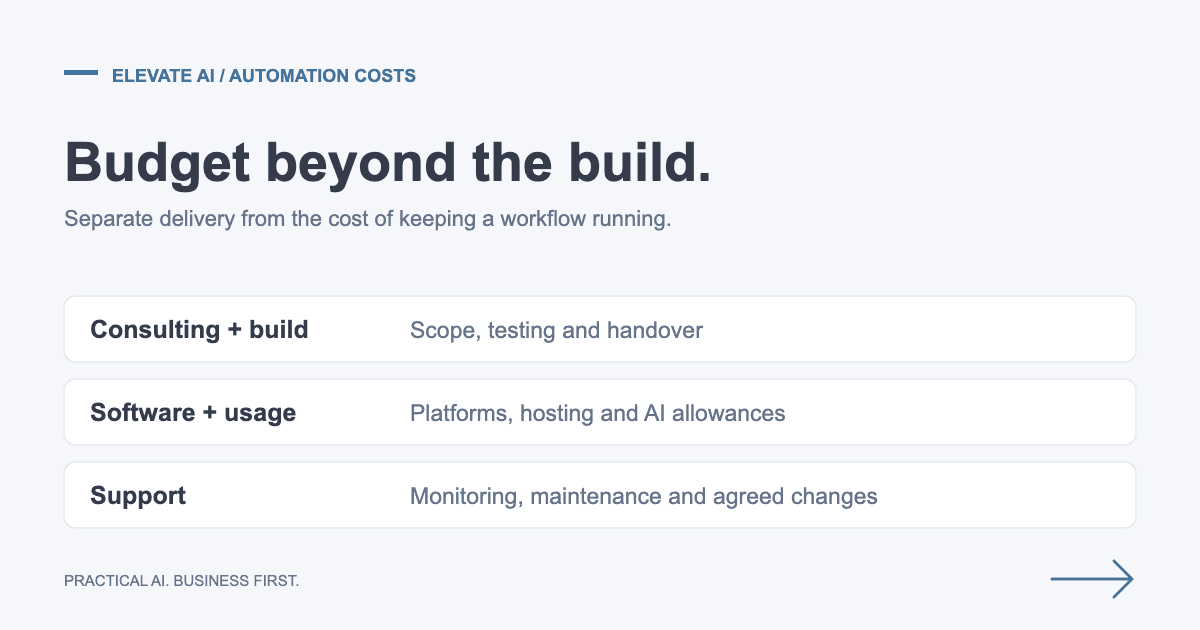
Hidden costs to allow for: software licences, API usage, data clean-up, staff training time, internal process changes, and any custom middleware for systems without clean integrations. A good proposal should separate build cost from ongoing running cost so you understand the full annual budget.

Compare scope, deliverables and service terms in your proposal. See our current pricing approach.

Why prices vary so much across the market

You will find consultancies quoting anywhere from £1,500 to £100,000 for what sounds like the same thing. The difference usually comes down to five factors.

Scope. A single workflow automation is a very different job from connecting five systems with custom logic, error handling, and compliance requirements. The more processes involved, the higher the cost.

Integration complexity. Connecting to a well documented API is straightforward. Connecting to a legacy system with no API, or building custom middleware, takes more time and skill.

Compliance requirements. If you operate in a regulated sector like financial services or healthcare, extra layers of access control, audit logging, and data handling are needed. That adds to the build.

Agency model. Large consultancies carry higher overheads and often add layers of project management, account management, and strategy work. That is not necessarily bad, but it does increase cost. Smaller specialist firms tend to be leaner and faster.

Ongoing support model. Some agencies bundle generous ongoing support into the project price. Others charge separately. Make sure you understand what happens after go live before you sign anything.

How to structure an engagement that protects your budget

The biggest financial risk in AI automation is not the technology. It is committing too much money before you know whether the approach works in your business. Here is how to avoid that.

Start with a pilot. A good consultancy will offer a paid pilot that automates one real workflow and produces measurable results. If they insist on a large discovery phase before building anything, that is a warning sign. You should see working automation within weeks, not months.

Insist on milestone payments. For larger projects, payments should be tied to delivery milestones. Do not pay the full amount upfront. A sensible structure might be 30% on kickoff, 40% on delivery of the working system, and 30% after a live testing period.

Avoid lock in contracts. Compare any minimum term, notice period, handover and ongoing support responsibilities before signing. If an agency requires a 12 month commitment for support, ask why. Good agencies keep clients because the service is valuable, not because the contract traps them.

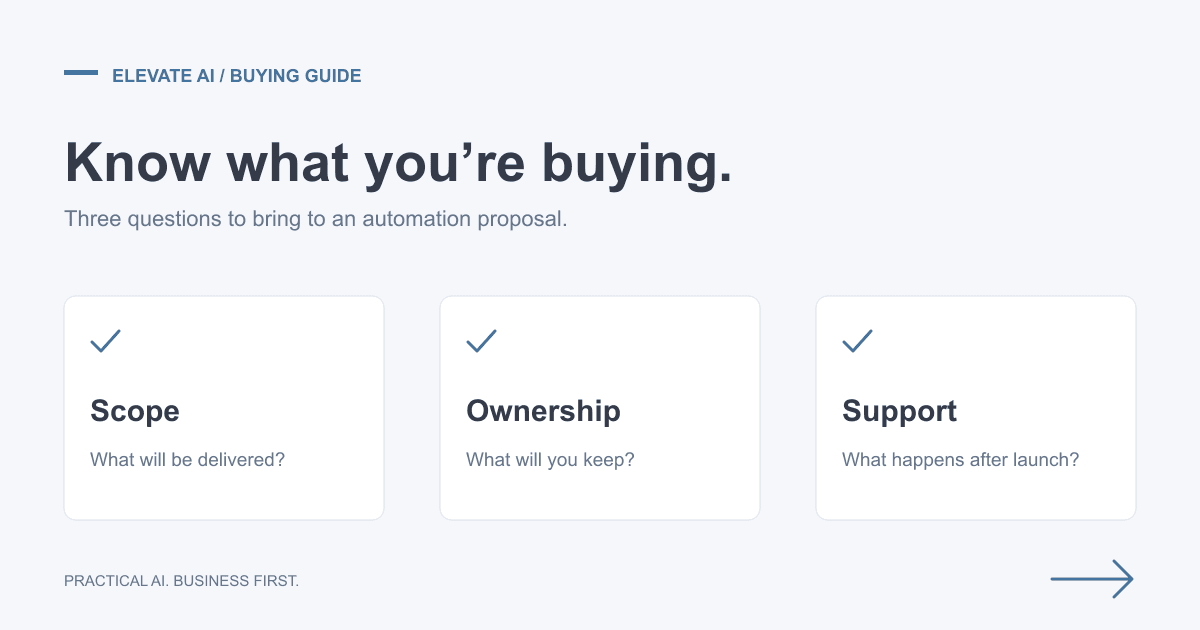
Get a clear scope document. Before any work starts, you should have a written scope that lists exactly what will be automated, what systems are involved, what the deliverables are, and what is not included. This protects both sides.

Bad quote warning signs

Be careful if an AI automation quote makes the outcome sound certain before the workflow has been mapped. The riskiest quotes usually hide delivery detail behind impressive language.

  • Vague scope: the quote says "AI transformation" but does not name the workflow, trigger, systems, output, or owner.
  • No human approval design: customer-facing, financial, legal, or regulated outputs are automated without a review step.
  • No failure handling: there is no alert, fallback, or manual process if the automation breaks.
  • Unclear ownership: you do not know who owns the workflow files, credentials, accounts, prompts, and documentation after launch.
  • Hidden running costs: platform, API, hosting, usage, storage, or support costs are not separated from the build fee.
  • No baseline measurement: the proposal does not say how response time, admin hours, CRM quality, errors, or throughput will be measured.

AI automation quote comparison checklist

When two quotes look similar, compare the operating detail rather than just the headline price. A strong proposal should answer these questions in plain English:

  • Workflow: which process is being automated, where does it start, and what should happen at the end?
  • Systems: which CRM, inbox, forms, spreadsheets, documents, calendars, finance tools, or databases are involved?
  • Data quality: what happens when data is missing, duplicated, outdated, or formatted badly?
  • Human approval: where must a person review output before it reaches a customer, prospect, supplier, or regulated record?
  • Failure handling: what alert, fallback, or manual process runs if the automation fails?
  • Ownership: who owns the workflow, accounts, documentation, credentials, and source files after launch?
  • Support: what is included after go-live, what costs extra, and how quickly will issues be handled?
  • Running costs: are platform, usage, API, hosting, storage, or extra seat costs included or billed separately?
  • Measurement: what baseline will be measured before launch, and how will ROI be reviewed after 30 to 90 days?

A cheaper quote can become expensive if it excludes testing, documentation, training, support, or error handling. A more expensive quote may be better value if it includes safer delivery and clearer accountability. If you want a practical example of how a scoped automation discussion turns into a delivery plan, read the Impact Chauffeurs workflow scoping story. If you are still building your shortlist, our UK AI automation agencies guide explains how to compare different providers fairly.

What to look for in a UK AI automation consultancy

Price is important, but it is not the only factor. Here are the things that matter most when choosing a partner.

Published pricing. If a consultancy will not give you a ballpark until you have been through a sales process, they are optimising for their pipeline, not your time.

A pilot first approach. You want to see results before committing significant budget. A pilot can be useful after diagnosis, with agreed success measures and a scope that tests the main risks.

ROI accountability. Ask how the agency defines success, how they measure the baseline, and what happens if the first version does not meet the agreed target. A strong partner should be willing to refine the workflow against clear success criteria rather than disappear after go-live.

Sector experience. Automation in financial services is different from automation in recruitment. Make sure your consultancy has worked with businesses like yours and understands the specific compliance, workflow, and integration challenges.

Transparent tech stack. You should know what platforms and tools will be used. At Elevate AI, we build on n8n, Make, and custom AI integrations. You should also understand who owns the automations once they are built. Avoid agencies that create proprietary lock in.

Common pricing traps to avoid

The free audit that leads to a huge quote. Some consultancies offer a free discovery session specifically to build a case for a large project. That is not inherently wrong, but be cautious if the recommendation always seems to be a £50,000 engagement regardless of the problem.

Day rate without scope. A day rate of £800 to £1,500 means nothing without a clear estimate of how many days are needed. Always push for a fixed price or a capped estimate tied to deliverables.

Hidden platform costs. Some agencies charge for building the automation but then require you to pay separately for the platform it runs on. Understand the full cost of ownership before signing.

Over scoping. If a consultancy recommends automating 15 processes at once, they are either trying to inflate the project or they do not understand how change management works in an SME. Start small, prove value, then expand. Our guide to quick wins for UK SMEs explains how to pick the right first workflow.

A simple ROI model for SME automation

Before approving spend, build a simple model. Multiply the hours saved each week by the loaded hourly cost of the people doing the work, then add any extra value from faster response times, fewer errors, or more consistent follow-up. Keep the model conservative; if the project only works with optimistic assumptions, it is not the right first workflow.

Example: a workflow that saves 8 hours per week at a loaded cost of £30 per hour creates £240 of weekly capacity. That is roughly £12,480 per year before accounting for quality improvements. A £4,000 pilot with that profile has a credible payback case, provided the workflow is adopted and maintained.

The same model can be used for CRM hygiene, document processing, reporting, onboarding, and lead response workflows. The strongest use cases usually combine time savings with better commercial follow-through.

What ROI should you expect?

For a well chosen automation project, UK SMEs typically see ROI within three to six months. The return comes from direct time savings, reduced error rates, faster turnaround, and the ability to handle more volume without hiring. A pilot project costing £3,000 to £5,000 that saves 10 hours per week at a loaded cost of £25 per hour pays for itself in 12 to 20 weeks.

The key word is "well chosen." A weak use case will produce a weak return regardless of how good the technology is. That is why the pilot approach matters. It forces both you and the consultancy to focus on the workflows that will deliver the biggest commercial impact first.

For a deeper look at returns, read our guide on what ROI UK SMEs can expect from AI automation.

How Elevate AI pricing works

Elevate AI starts with paid AI Consulting: understand the business problem, prioritise opportunities and leave with a costed roadmap you own. Implementation is scoped separately if the roadmap supports it. A free scoping call establishes fit, scope and the engagement price; detailed analysis belongs to the paid work.

Compare scope, deliverables and service terms in your proposal. See our current pricing approach.

Next steps

To discuss your AI priorities and the advice you need, explore our AI Consulting engagement or book a free scoping call. The call establishes fit and scope. Detailed discovery, opportunity analysis and a costed roadmap are paid deliverables; implementation is agreed separately.

For the fastest route, start with the pricing page, then bring one workflow you suspect is wasting time, leaking leads, or creating admin drag. We will help you decide whether it belongs in a pilot, a wider implementation, or not in an automation project at all.

You might also find these useful: our AI automation quote comparison checklist, our guide to AI agent use cases for UK businesses, or our overview of what to expect from AI consulting in the UK.

A conversation is a good place to start

Make it useful for your business.

Talk through your priorities and explore whether AI Consulting or the Outbound Sales Engine is the right next step.

Book a scoping call