There is no defensible universal percentage saving or payback period for SME automation. Your return depends on the work being changed, how often it happens, what still needs human review, total costs and whether the team uses the result.
The useful question is: what would this specific workflow need to achieve to justify its cost? Start with your own baseline, label estimates clearly and measure what happens after launch.
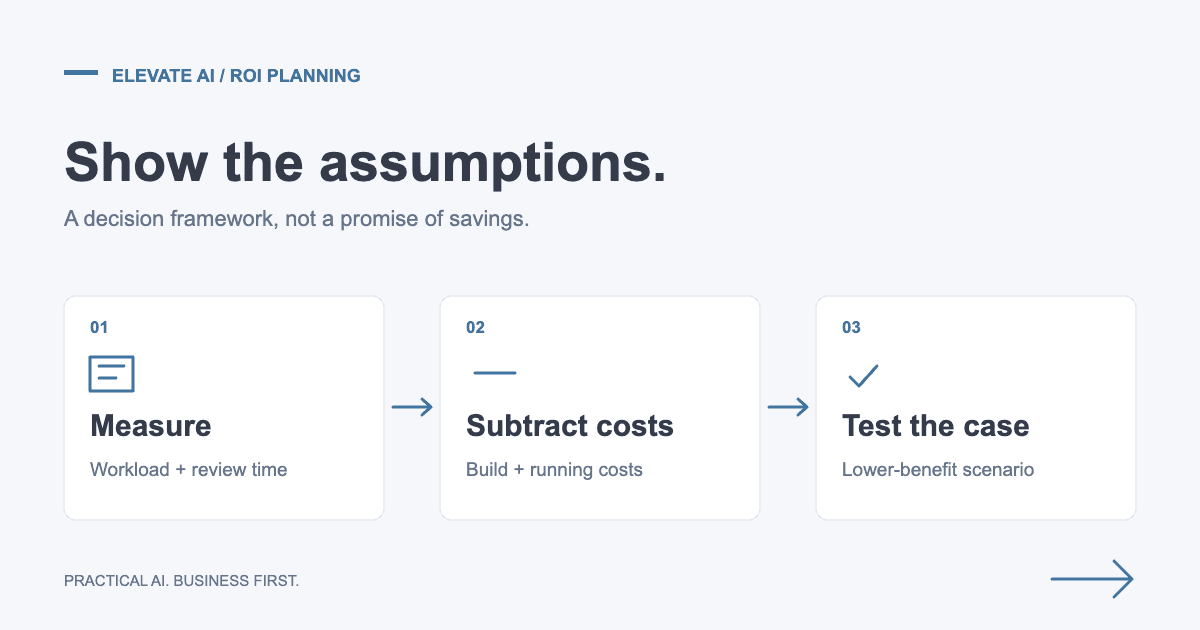
Measure the work before modelling savings
Record a representative period that includes ordinary work and exceptions. Capture volume, handling time, checking and rework, not just the fastest successful example. Separate staff effort from elapsed waiting time: a job waiting overnight is not necessarily eight hours of paid work.
- How many items are processed, and how variable are they?
- How much time is spent entering, checking and correcting each item?
- Which decisions must remain with a person?
- What is the current error rate, with a defined error and denominator?
- Which costs would genuinely change if handling time fell?
Released capacity is not automatically cash saved
If a salaried employee spends fewer hours on admin, payroll may stay unchanged. That released capacity can still be valuable: the person may complete more work, improve service or avoid additional overtime. Record that benefit separately from an actual reduction in expenditure.
For a cash-return calculation, use costs genuinely avoided or additional contribution supported by evidence, not just salary multiplied by time. Do not count the same hours both as a salary saving and as the source of extra revenue.
A worked example you can replace with your own figures
These are illustrative assumptions, not a client result, market benchmark or Elevate AI quote. Assume a workflow takes 10 staff hours a week today, and testing suggests it would take 4 hours including review and exceptions. Use 48 operating weeks and a loaded hourly cost of £30.
| Calculation | Illustrative result |
|---|---|
| Weekly capacity released: 10 − 4 hours | 6 hours |
| Annual capacity value: 6 × 48 × £30 | £8,640 |
| Annual software, AI usage and support: £200 × 12 | £2,400 |
| Annual capacity value after running costs | £6,240 |
| One-off consulting, build and training assumption | £6,000 |
| First-year costs: £6,000 + £2,400 | £8,400 |
| First-year net modelled value: £8,640 − £8,400 | £240 |
Using total first-year cost as the denominator, the modelled capacity-value return is £240 ÷ £8,400, or approximately 2.9%. Simple payback on the £6,000 one-off spend is about 11.5 months at the assumed steady-state net benefit. This excludes ramp-up and is not a cash-payback claim unless the capacity can actually be converted into financial benefit.
Keep the VAT treatment consistent with your business and do not omit internal training, transition or support time. If software or support is included in a bundled fee, avoid counting it twice.
Test a less optimistic scenario
If the same workflow releases only 3 hours a week, annual capacity value becomes £4,320. After £2,400 running costs, just £1,920 remains towards recovering the £6,000 investment. Simple payback becomes about 37.5 months under the same assumptions.
That sensitivity is more useful than a generic promise of three-month payback. If the business case only works at the most optimistic volume or adoption level, narrow the scope, test the uncertain step or defer the project.
What can a case study actually prove?
Our electrical-contractor story demonstrates completed diagnosis and a phased roadmap. It does not establish measured post-implementation savings. Our outbound data-quality case study reports records reviewed and recovered; those counts are not sales or revenue.
Apply the same distinction when assessing any supplier: delivered work, forecast benefit and realised business outcome are different kinds of evidence. A clear description of a modest verified result is more useful than an unsupported percentage.
Measure the result after launch
Compare equivalent workloads and record adoption, review time, failures and rework. Explain seasonal or staffing changes that affect the comparison. Track error counts against the number processed; automation can repeat a mistake consistently, so lower handling time alone is not proof of better quality.
For outbound work, separate researched prospects, genuine replies, qualified opportunities and completed sales. A reply or meeting should not be assigned a revenue value without a supported commercial outcome.
When not to automate
A low-volume task may not justify a build, although risk reduction could still matter. An unstable process may need clearer ownership before technology. A simpler rule or an existing software feature may solve the problem without AI.
Our paid AI Consulting engagement helps prioritise those decisions and produces a costed roadmap you own. Implementation is separate. Book a free scoping call to discuss fit, or use the automation cost guide to assemble the full budget first.