
Business process automation UK SME searches are usually a sign that a team has hit the same wall: too much work is getting done through inboxes, spreadsheets, and manual follow up. The good news is that most small and mid sized businesses do not need a massive transformation programme to fix it. In practice, the fastest wins come from a short list of repetitive workflows that drain time every single week.
At Elevate AI, we usually start by looking for tasks that happen often, follow a recognisable pattern, and create a cost every time someone has to chase, copy, or correct something. For a typical UK SME with 10 to 50 staff, the first 90 days of automation should be focused on relief, not complexity. You want saved hours, fewer mistakes, and cleaner visibility.
If you are still deciding whether the numbers stack up, our guides on ROI from AI automation, typical project pricing, and workflow automation consultant vs agency vs DIY will help frame the investment properly.
Why business process automation matters for UK SMEs
Large firms can hide inefficient processes behind headcount. SMEs cannot. If a five person operations team wastes six hours a week each on manual updates, approvals, and rekeying data, that is 30 hours gone before anyone has done anything strategic. At £25 to £40 per hour in loaded staffing cost, that is £750 to £1,200 disappearing every week.
The aim is not to automate everything. The aim is to remove repeatable friction. When that is done well, the business moves faster without hiring ahead of revenue.
Quick win 1: Lead capture and follow up
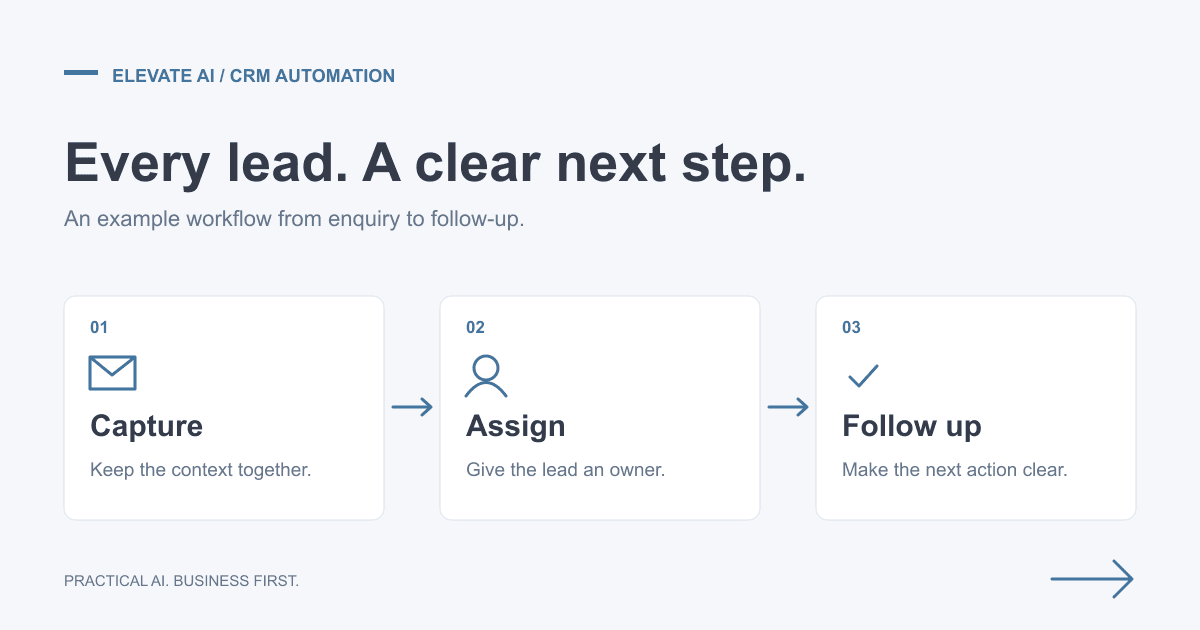
This is usually the easiest starting point. A prospect fills out a form, books a call, downloads a guide, or replies to a campaign. Too many SMEs still route that enquiry through shared inboxes or manual CRM updates. That creates delays, duplicate entries, and missed follow up.
A simple automation can push the lead into the CRM, notify the right person, assign an owner, and trigger the first email or task instantly. For firms handling 20 to 100 inbound leads a month, that often saves 3 to 5 admin hours weekly and improves response time from hours to minutes.
We cover the sales side in more detail in our AI lead generation guide, but the key point is simple: speed and consistency matter more than fancy tooling.
Quick win 2: Client onboarding for professional services
For accountants, consultants, recruiters, and other firms in professional services, onboarding is one of the biggest sources of friction. New clients need forms, documents, internal checks, kickoff emails, and task creation. When this is handled manually, it is slow and uneven.
A structured onboarding workflow can send forms automatically, create project tasks, generate document requests, and keep the team updated. In most SMEs this saves 30 to 60 minutes per client. Across 20 new clients a month, that is 10 to 20 hours back immediately.
If this is your bottleneck, read our client onboarding breakdown next.
Quick win 3: Invoice and payment chasing
Cash flow suffers when finance relies on memory. In many businesses, invoices are sent on time but reminders are inconsistent, or staff spend Friday afternoons manually checking who has paid. A better setup links your finance tool, CRM, and email rules so reminders go out at the right points, internal alerts are created for overdue accounts, and exceptions are escalated properly.
For an SME billing £50,000 to £250,000 a month, even a modest reduction in debtor days can have more impact than the labour saving alone. I have seen businesses pull average payment time down by 5 to 9 days just by standardising reminders and internal ownership.
Quick win 4: Internal approvals and sign off
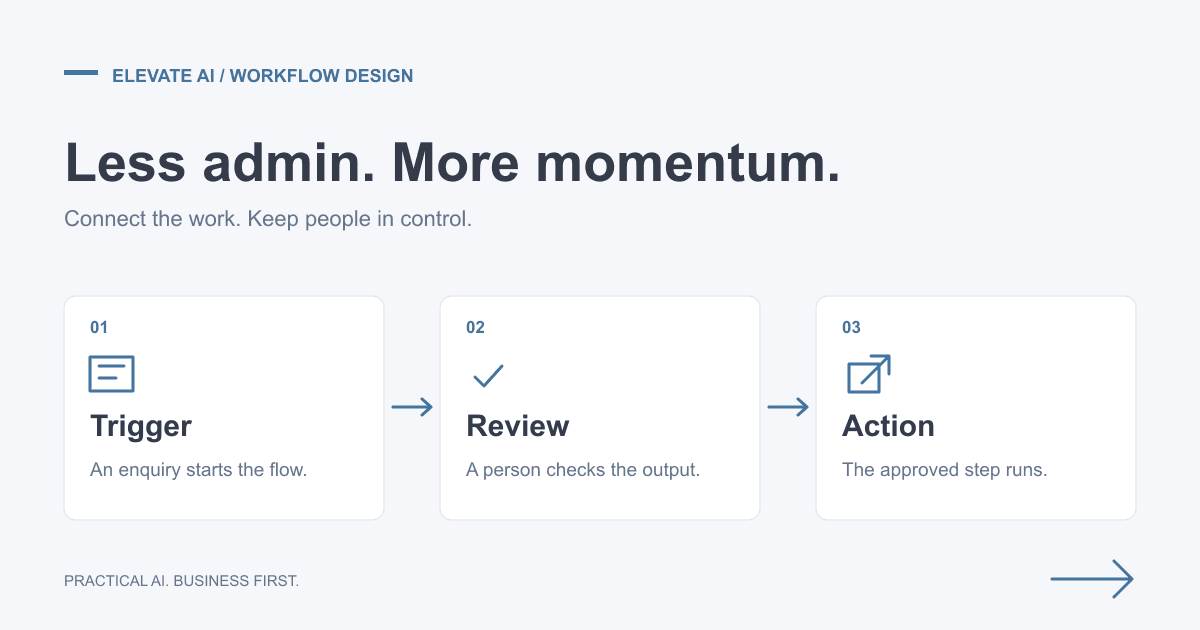
Purchase approvals, discount approvals, holiday requests, content sign off, expense authorisation. These rarely look urgent in isolation, but together they create a lot of drag. Work gets stuck because the request is in an email chain, nobody knows who owns the next step, or a manager forgets to reply.
A lightweight approval flow with clear rules can remove hours of slack every week. It also creates an audit trail, which matters in regulated environments and any business that wants tighter operational discipline.
Quick win 5: Reporting that updates itself
Manual reporting is one of the most expensive bad habits in UK SMEs. A founder or ops lead pulls numbers from three systems, cleans the spreadsheet, fixes labels, then sends the same report every Monday. If that takes two hours a week, that is more than 100 hours a year on one report.
Automated reporting does not need to be complicated. Pull the data from source systems, standardise it once, and send a dashboard or digest on schedule. This is one of the clearest areas where AI agents can help, especially when commentary or exception spotting is useful alongside raw numbers.
Quick win 6: Customer service triage
Not every customer query needs a person first. Many need routing first. That is a crucial difference. Businesses searching for business process automation UK SME help are often dealing with scattered enquiries from contact forms, email, WhatsApp, and live chat. Staff spend too much time sorting and forwarding instead of solving.
A triage workflow can categorise incoming requests, attach the right information, and route them to the correct queue. Where appropriate, an AI assistant can answer routine questions or gather context before handoff. If you are considering this route, pair it with our guide to AI chatbots for UK businesses so the automation stays useful rather than gimmicky.
Quick win 7: Recruitment and hiring admin
Hiring creates a surprising amount of repeat admin. CV acknowledgement, interview scheduling, scorecard reminders, offer pack generation, and onboarding handover can all be automated. Recruitment firms can go further, which we outline in our recruitment agency guide, but even non recruitment SMEs can remove a lot of busywork here.
A team hiring just two people a month can save several hours of coordination, and candidates get a much better experience when communication is prompt and consistent.
How to choose the right first workflow
Use three filters. First, frequency: does it happen every day or every week. Second, stability: does the process follow recognisable rules. Third, value: does a failure here cost time, revenue, or trust. If a workflow scores well on all three, it is a strong automation candidate.
Avoid starting with the most complex process in the business. Start with the one that hurts often, is easy to measure, and can be deployed quickly. That is how you build confidence internally.
What a sensible first 90 days looks like
Weeks 1 and 2 should be process mapping and prioritisation. Weeks 3 to 6 should be build and testing. Weeks 7 to 10 should be live use with monitoring. By week 12, you should have actual numbers: hours saved, handoff time reduced, error rate improved, or cash collected faster.
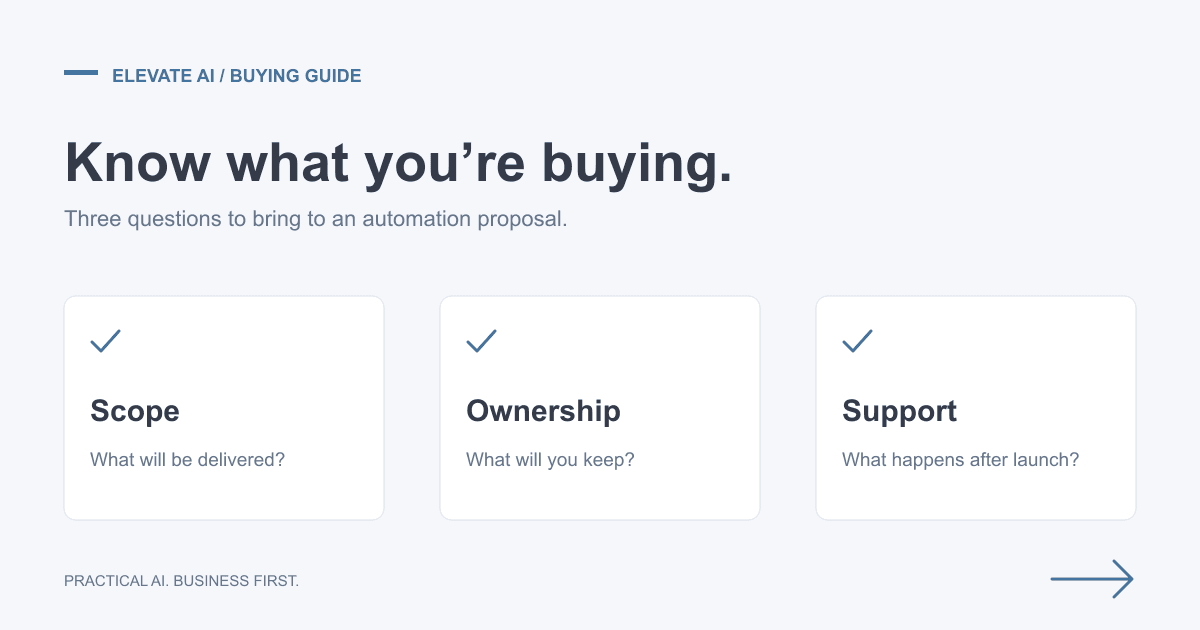
If a provider cannot explain how success will be measured in plain English, pause. Automation should reduce friction, not create another layer of it.
Final thought
Business process automation UK SME projects work best when they start small and prove themselves quickly. The aim is not to show how clever the tech is. The aim is to give your team breathing room and create an operation that scales properly.
To discuss your business priorities, explore our AI Consulting engagement or book a free scoping call. The call establishes fit and scope. Detailed discovery, opportunity analysis and a costed roadmap are paid deliverables; implementation is agreed separately.