AI consulting should help you decide what is worth changing before you commit to a build. The useful output is not a list of tools: it is a prioritised plan connecting a business problem to a feasible solution, its costs and the decisions needed to proceed.
At Elevate AI, AI Consulting is a paid engagement producing a standalone, client-owned roadmap. The initial scoping call is free; detailed discovery and analysis are not. Implementation is a separate decision and is scoped and priced separately.
What should an AI consulting engagement include?
- Discovery: follow the work with the people doing it. Identify inputs, systems, handoffs, exceptions and the person responsible for each decision.
- Opportunity mapping: consider process improvements and existing software as well as AI. A missing approval rule is not necessarily a technology problem.
- Prioritisation: weigh potential value against feasibility, effort and dependencies. Record what should wait and why.
- Solution design: describe the proposed workflow, required data, human decisions and what should happen when something fails.
- Implementation planning: define the sequence, responsibilities and approval points rather than treating every idea as an immediate commitment.
- Costs: separate indicative estimates from firm quotations, and one-off delivery from ongoing software, usage and support costs.
A real example: an electrical contractor's operations roadmap
In our published electrical-contractor case study, the diagnostic followed information from incoming orders through job records, engineer notes and invoicing. The business wanted less repetitive office work while retaining the systems and working knowledge its team relied on.
An on-site walkthrough and read-only operational analysis informed a phased roadmap. It distinguished opportunities to pursue, ideas to defer and actions needing no new software. Human approval remained part of the proposed financial and operational workflows.
The completed result was the diagnostic and roadmap, not a claim that the proposed automation had already saved a certain number of hours. That distinction matters when assessing any consultant's evidence: ask what was actually delivered and what remains a forecast.
How do you judge whether a roadmap is useful?
Take one recommendation and ask whether another delivery team could understand the problem, the proposed approach and the outstanding decisions. A useful roadmap makes assumptions visible; it does not pretend that every integration or exception has already been proven.
- What is the current process, and which evidence supports the problem?
- Why does this opportunity come before the others?
- What data, access or supplier cooperation is needed?
- Which actions need approval, and who owns exceptions?
- What must be tested before a fixed implementation scope can be agreed?
- What would make the business defer or reject the idea?
Does consulting have to lead to a pilot or a full build?
No. If the process itself is unclear, discovery may be the right investment before choosing technology. If a specific technical uncertainty remains, a bounded proof of concept may help answer it. If your existing software can solve the problem through configuration or a simpler process, a new AI build may add unnecessary cost.
For an illustrative order-processing workflow, testing whether varied order documents can be read accurately is a different decision from deploying unattended updates to a live finance system. A successful document test does not remove the need for matching rules, approvals, exception handling and operational testing.
What does AI consulting cost in the UK?
There is no reliable single price without a defined scope. The number of processes, depth of investigation, available evidence and required deliverables all affect the work. Ask suppliers to price the same brief rather than treating an unsourced industry range as a benchmark.
For Elevate AI, the consulting fee, deliverables and schedule are agreed before work starts. The roadmap belongs to you and can be implemented with us, your own team or another provider. See our current pricing approach and the quote comparison checklist.
What should you ask about support?
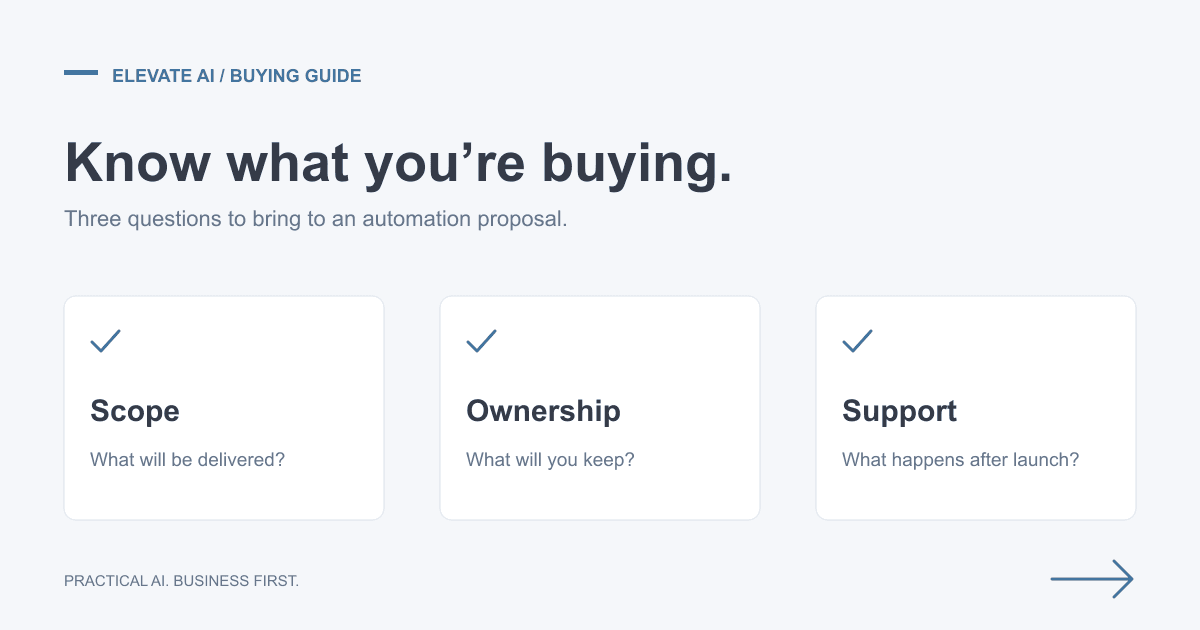
For any later implementation, establish what testing, handover and post-launch defect correction the build includes. Then distinguish ongoing monitoring and maintenance from new development. A support arrangement should name the live workflows, responsibilities, response expectations, small-change boundaries and software or AI usage charges.
Do not assume support is included in consulting, or that a monthly fee includes unlimited changes. Those are implementation and service-agreement questions. Our automation cost guide explains how to separate these budget lines.
Prepare for the first conversation
Bring one process you would like to improve, the systems involved and any existing measure of volume, handling time or errors. Include the exceptions: the unusual order or incomplete record often explains more about the real work than a perfect example.
You do not need a technical brief. Book a free scoping call to discuss fit and scope; detailed investigation and the costed roadmap belong to the paid engagement.