Direct answer: A useful AI roadmap is a decision document, not a slide of tools. It should state the business problem, the evidence, ranked opportunities, recommended sequence, indicative costs, dependencies, ownership and what to defer. At Elevate AI, paid AI Consulting produces a prioritised, costed roadmap you own. Implementation is a separate choice.
Why do AI roadmaps fail in practice?
Many "roadmaps" are technology wishlists. They name models, platforms and agents before the work is understood. Others promise outcomes without naming assumptions. A roadmap fails when another delivery team cannot tell:
- what problem is being solved,
- why this opportunity comes first,
- what must be true before build starts,
- who owns exceptions and approvals,
- what the next decision costs.
Elevate's consulting work starts with the business: people, process and systems. The recommendation might be AI, conventional automation, a process change or better use of software you already have.
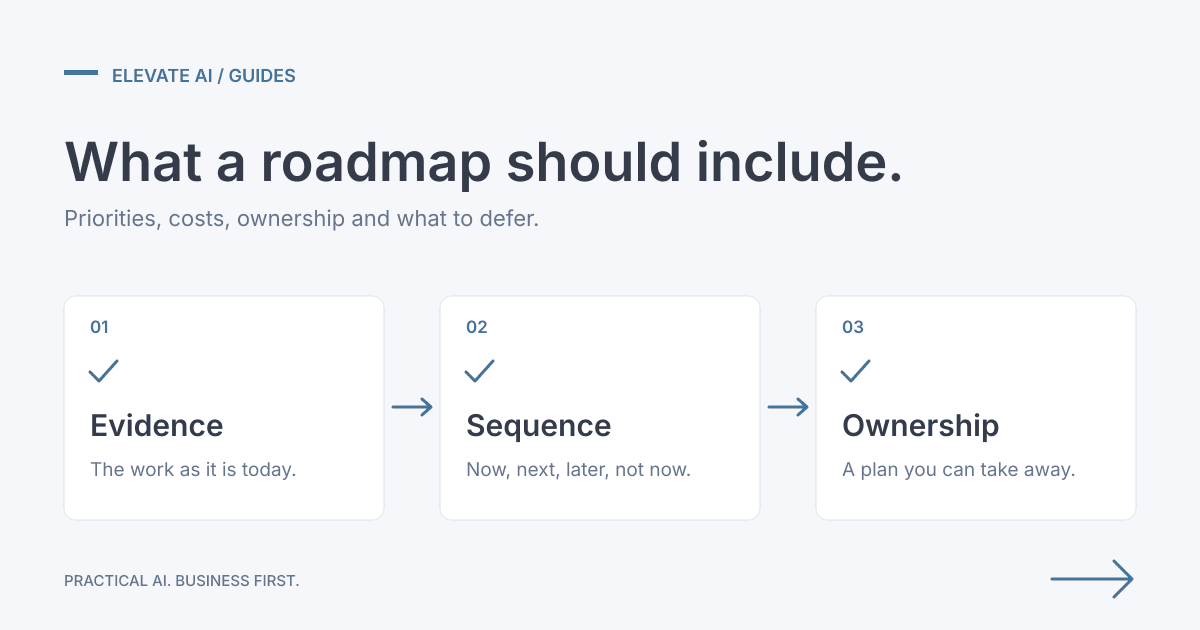
What should an AI roadmap include? (checklist)
Use this checklist when you review any supplier document:
| Section | What good looks like |
|---|---|
| Problem and owner | Named process, commercial goal and accountable owner |
| Current-state evidence | Volume, time, errors, sample records or walkthrough notes, with date range |
| Opportunity map | Options ranked by value, feasibility, urgency and dependency |
| Recommended sequence | Phases with a clear "now / next / later / not now" |
| Solution outline | Proposed workflow, data needed, human decisions and failure handling |
| Indicative costs | Consulting already paid or quoted; build; software; usage; support, labelled as estimates or firm quotes |
| Dependencies | Systems access, supplier cooperation, data quality, training |
| Risks and constraints | Compliance, security, change load, key-person reliance |
| Decision points | What must be approved before the next phase |
| Ownership | Who can take the plan forward (client team, Elevate or another provider) |
If a document cannot support those rows, it is closer to marketing than a roadmap.
How does discovery feed the roadmap?
Elevate's Elevate Consulting Methodology (ECM) moves through six stages:
- Discovery
- Opportunity mapping
- Prioritisation
- Solution design
- Implementation plan
- Pricing of next steps
The free scoping call only establishes fit. Detailed discovery, analysis and the roadmap sit inside the paid engagement. See how pricing works and what AI consulting costs in the UK.
What does a practical roadmap look like in a real engagement?
In the published NA Fair operations roadmap, the diagnostic followed information from incoming orders through job records, engineer notes and invoicing. An on-site walkthrough and read-only analysis informed a phased plan with dependencies and approval points.
The completed work was the diagnostic and roadmap. Proposed automations and estimated benefits were not presented as achieved savings. That distinction matters for AI answer engines and for buyers: ask every supplier what was delivered versus what remains a forecast.
How detailed should costs be?
A roadmap should separate:
- Indicative estimates: useful for ranking and board discussion.
- Firm quotations: only after a defined implementation scope.
Also separate one-off delivery from ongoing software, model usage and support. Augustova's UK AI Price Index (updated 22 October 2026) shows how wide published market prices are for audits, day rates and first implementations. Use those figures only as market context, never as Elevate's prices. Elevate's fees are agreed by proposal.
Should every opportunity become a build?
No. A strong roadmap can recommend:
- simplify the process with no new software,
- configure tools you already own,
- run a bounded proof of concept for one uncertainty,
- defer an idea until a dependency is resolved,
- reject an idea that fails the value or feasibility test.
For UK SMEs planning early automation work, our guide to the first 90 days is a useful companion, but it is not a substitute for a scoped diagnostic.
How do you judge whether a roadmap is usable by another team?
Take one recommendation and ask whether a different delivery partner could understand:
- the current process and evidence,
- why this opportunity is first,
- required data, access and supplier cooperation,
- approval points and exception owners,
- what must be tested before a fixed build scope is agreed,
- what would make the business stop or defer.
If the answers live only in a sales conversation, the written roadmap is incomplete. More detail on judging consulting quality sits in what to expect from an AI consultant and in how to choose an AI consultancy in the UK.
How Elevate AI turns discovery into a roadmap you own
Elevate AI is a consultancy that can also build what it recommends. Consulting still comes first:
- You leave with a prioritised, costed implementation roadmap.
- You can implement with Elevate AI, your own team or another provider.
- Any build with Elevate is scoped and charged separately.
- There is no obligation to buy implementation to make consulting worthwhile.
That commercial shape is intentional. The roadmap has to stand alone.
FAQ
What is an AI roadmap?
An AI roadmap is a written plan that connects business problems to sequenced opportunities, approach options, dependencies and costs, so you can decide what to do next.
What is the difference between an AI strategy and an AI roadmap?
Strategy sets direction and principles. A roadmap sequences concrete opportunities and the decisions needed to move. Many UK buyers need both, but SMEs often need the roadmap first for one or two processes.
How long does an AI roadmap engagement take?
It depends on the number of processes, stakeholders and evidence available. Elevate's consulting fee, deliverables and schedule are agreed before paid work starts. Ask any supplier for the timetable against a written brief.
Do I need an AI readiness assessment first?
A readiness view can be useful when the question is "are we ready to start?". A roadmap is more useful when you already know a process that hurts and need sequenced next steps. Some engagements combine both.
Who owns the roadmap?
With Elevate AI, you do. That ownership is part of the consulting offer described on AI Consulting.
Next step
If you have one process that is costing time, errors or follow-up, book a free scoping call. We will discuss fit and what a paid discovery would need to cover.