
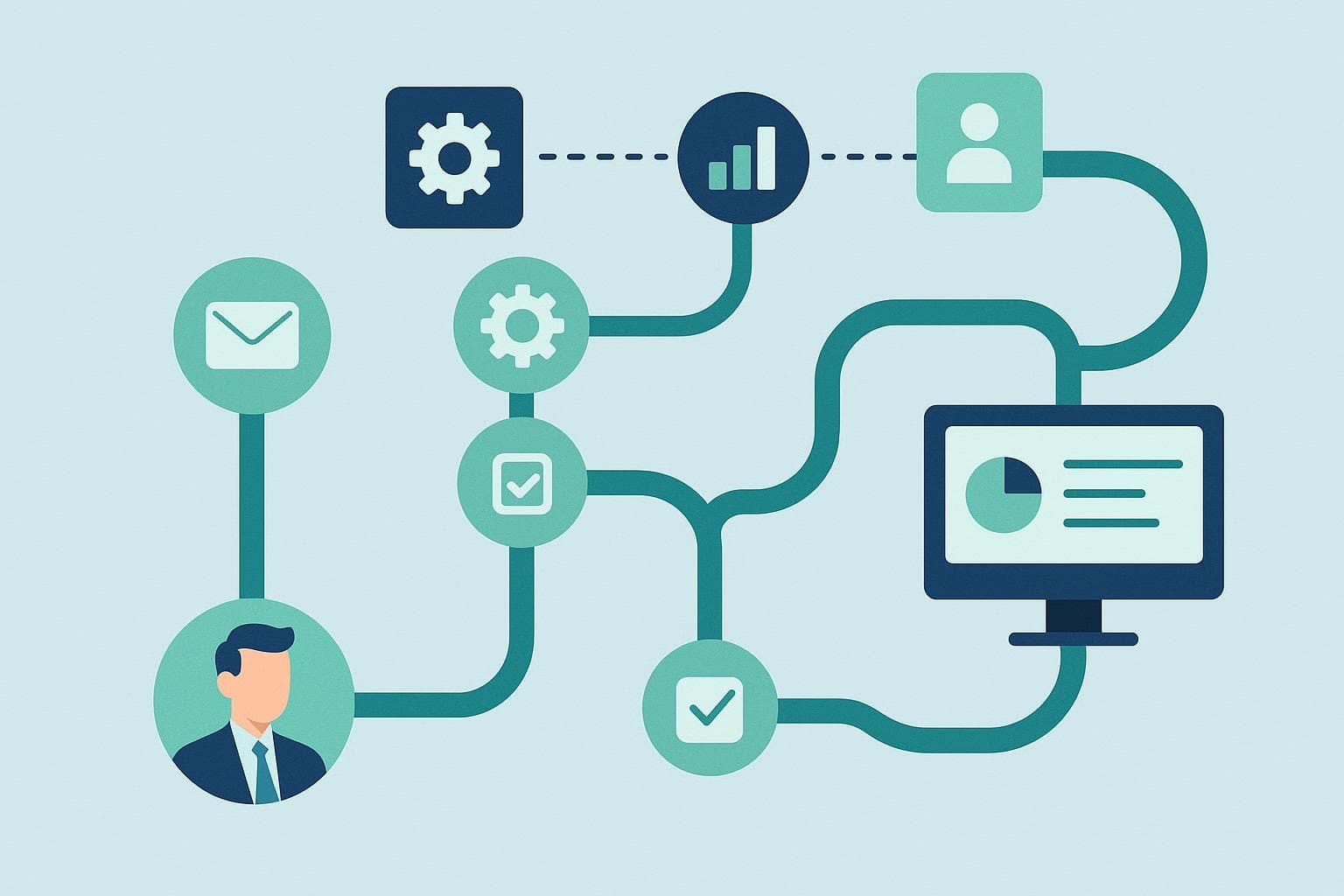
Workflow automation examples are most useful when they are tied to real business pressure: slow follow up, messy handovers, duplicated admin, missed reports, and work that lives in somebody's inbox. For UK SMEs, the strongest automation projects are rarely the flashiest. They are the repeatable workflows that save time every week and make the business more reliable.
This guide sets out twelve practical examples we would consider during a workflow automation consulting audit. Each one has a clear owner, measurable benefit, and a sensible place for human review.
If you already know you want help building the first version, compare our AI automation services, how Elevate AI pricing works, and UK AI automation agency approach before choosing a supplier.
1. Inbound lead capture and CRM creation
When a lead arrives from a website form, email campaign, LinkedIn conversation, referral, or booking link, the workflow should create or update the CRM record, capture the source, assign an owner, and trigger the right next step. This improves response speed and stops good enquiries going missing.
2. Lead qualification and routing
An AI-assisted qualification workflow can score a lead using budget, role, company fit, urgency, industry, and the problem described. Strong leads can be routed to sales immediately, while lower-fit enquiries receive a useful nurture sequence. For more depth, read our guide to AI agents for lead qualification and CRM follow-up.
3. Email triage and draft responses
Shared inboxes become expensive when every message has to be read manually. A workflow can classify enquiries, attach customer context, draft a reply, and escalate urgent or sensitive cases. The safest version keeps a human approval step before anything customer-facing is sent.
4. Client onboarding
Onboarding often involves welcome emails, forms, document requests, internal tasks, kickoff calls, folders, and CRM updates. Automating those steps saves admin and gives every new client a more consistent experience. This is especially valuable for professional services firms.
5. Proposal and quote preparation
Instead of starting from a blank page, a workflow can pull discovery notes, approved service descriptions, pricing rules, case study snippets, and open questions into a first draft. A senior person still reviews the proposal, but the repetitive assembly work is removed.
6. Weekly management reporting
Many SMEs lose hours every week creating the same report. A workflow can pull data from CRM, finance tools, ad platforms, spreadsheets, and support systems, then send a clean weekly digest with exceptions highlighted. This works particularly well when paired with AI agents that can summarise what changed.
7. Invoice and payment chasing
Finance workflows can identify overdue invoices, send staged reminders, notify account owners, and escalate high-value accounts. The benefit is not just time saved. Better follow-up can improve cash flow and reduce uncomfortable last-minute chasing.
8. Document processing
Forms, invoices, CVs, PDFs, onboarding packs, and contracts can be parsed, checked, categorised, and moved into the correct system. For regulated sectors such as financial services and healthcare, the workflow should include validation and human approval before sensitive actions.
9. Recruitment admin
Recruitment workflows can acknowledge applications, extract candidate details, schedule interviews, chase feedback, and update trackers. Recruitment agencies can go deeper with matching and shortlisting support, but final decisions should remain human-led.
10. Customer service escalation
A workflow can classify customer requests by urgency, sentiment, topic, and account value. Routine issues can receive templated or AI-drafted responses. Complex, emotional, or commercially sensitive issues should be escalated with context already attached.
11. Internal approvals
Discounts, expenses, content, hiring, purchasing, and project changes often get stuck in email. Approval workflows create a clear request, route it to the right person, track the decision, and keep an audit trail.
12. Post-meeting follow-up
After a sales call or project meeting, automation can summarise notes, identify actions, update CRM fields, create tasks, and draft the follow-up email. This is one of the easiest ways to improve execution without adding another meeting.
How to choose the first workflow
Use a simple filter: frequency, value, risk, and ease of measurement. The best first workflow happens often, costs real time or revenue, has clear rules, and can be measured within 30 to 90 days. Avoid starting with the most complex process in the company just because it looks impressive.
What a good pilot should include
A sensible pilot should include a workflow map, success metric, integration list, risk controls, human approval points, test cases, training notes, and a clear handover. At Elevate AI, we usually recommend one focused pilot before scaling into multiple workflows.
To discuss the workflows you want to improve, explore our AI Consulting engagement or book a free scoping call. The call establishes fit and scope. Detailed discovery, opportunity analysis and a costed roadmap are paid deliverables; implementation is agreed separately.
Related reading: workflow automation consultants, agencies, and DIY tools.


