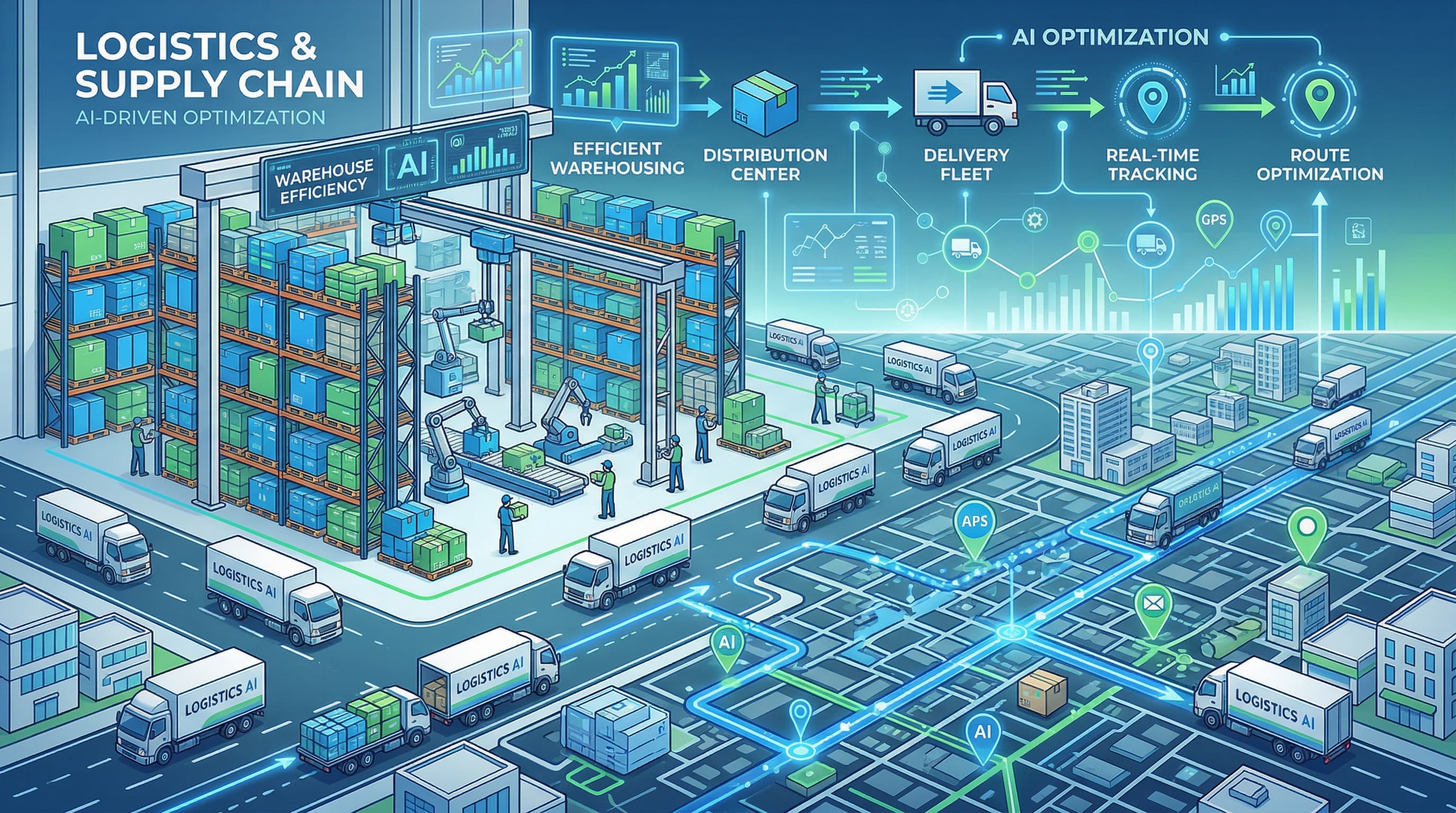
Logistics and supply chain operations in the UK are under more pressure than ever. Fuel costs remain high, the driver shortage persists, customers expect next day (or same day) delivery as standard, and margins in haulage and distribution are razor thin. For small and mid sized logistics businesses, the challenge is doing more with less while keeping service levels high.
AI automation will not solve every problem in logistics. But it addresses several specific, high impact areas where the combination of data analysis, prediction, and process automation can make a measurable difference to efficiency and cost. If you are exploring automation for the first time, our guide to workflow automation for UK businesses is a good starting point.
Route Optimisation
Route planning is the foundation of logistics efficiency. For a delivery business running 10 vehicles with 15 to 20 drops each, the number of possible route combinations is astronomically large. A human planner can produce a decent route, but "decent" and "optimal" are not the same thing. The difference between the two can be 15% to 25% in mileage, which translates directly to fuel cost, driver hours, and vehicle wear.
AI route optimisation analyses delivery addresses, time windows, vehicle capacity, driver hours regulations, traffic patterns, and road restrictions to produce routes that minimise total distance and time while meeting all constraints. Unlike static route planning, AI systems can also adapt in real time. If a delivery is refused or a new urgent pickup is added, the system recalculates the remaining route on the fly.
For a fleet of 10 vehicles averaging 200 miles per day, a 20% reduction in mileage saves roughly 400 miles per day, or 100,000 miles per year. At current diesel costs (approximately 50p per mile for a 7.5 tonne vehicle including fuel, tyres, and maintenance), that is £50,000 per year in direct savings. Add reduced driver overtime and the total impact is significant.
Several UK logistics firms we have worked with have also found that route optimisation allows them to handle 10% to 15% more deliveries per vehicle per day, reducing the need for additional vehicles and drivers as volumes grow.
Demand Forecasting
For logistics businesses that manage warehousing or distribution, predicting demand accurately is essential for staffing, capacity planning, and inventory management. Traditional forecasting relies on historical averages and manual adjustments. AI forecasting incorporates a much wider range of signals.
Historical order patterns, seasonal trends, weather forecasts, promotional calendars, economic indicators, and even social media trends can feed into demand prediction models. The result is forecasts that are typically 20% to 35% more accurate than traditional methods.
More accurate forecasting means better staff scheduling (fewer last minute agency workers at premium rates), more efficient warehouse space utilisation, reduced stock holding costs for distribution clients, and fewer service failures caused by capacity mismatches.
A distribution centre handling 5,000 orders per day that improves forecast accuracy by 25% can reduce temporary staffing costs by £30,000 to £50,000 per year while simultaneously improving fill rates and delivery reliability.
Warehouse Operations
Inside the warehouse, AI can optimise picking routes (the same principle as delivery route optimisation, applied to walking or driving routes within the facility), predict which products will be needed next and pre stage them for faster picking, identify slow moving stock that should be relocated to less accessible areas, and automate quality checks using computer vision.
For businesses not ready for full warehouse automation (which requires significant capital investment in robotics and conveyor systems), AI powered operational improvements offer a more accessible entry point. Optimised pick paths alone can increase picking productivity by 15% to 25%, which for a warehouse with 10 pickers equates to the output of 1.5 to 2.5 additional staff without the associated cost.
Shipment Tracking and Customer Communication
"Where is my delivery?" is the most common customer query in logistics. Handling these manually is repetitive and low value. An AI system integrated with your TMS (transport management system) and vehicle tracking can provide automated, real time updates to customers via email, SMS, or a tracking portal.
Beyond basic tracking, AI can predict delivery times more accurately by analysing current traffic, driver progress, and historical delivery patterns for the specific area. Instead of a four hour delivery window, customers get a 30 minute estimate that updates in real time. This kind of precision used to be exclusive to major carriers. AI makes it achievable for smaller operators.
Automated exception handling is equally valuable. If a delivery is going to be late, the system proactively notifies the customer before they need to chase. If a delivery attempt fails, the system automatically offers rebooking options. This reduces inbound query volumes and significantly improves customer satisfaction.
Supplier Management
For businesses managing inbound supply chains, AI can monitor supplier performance automatically. Delivery accuracy, lead time consistency, quality issues, and pricing trends are tracked and compiled into scorecards without anyone manually pulling reports.
The system can flag emerging issues before they become problems. If a supplier's lead times have been gradually increasing over the past three months, the AI alerts your procurement team before it causes a stockout. If quality rejection rates for a particular supplier spike, you know immediately rather than discovering it in a quarterly review.
Automated purchase order generation based on demand forecasts and current stock levels rounds out the supply chain automation. The system calculates what is needed, when, and from which supplier, generating POs for review and approval. This is particularly valuable for businesses managing complex, multi supplier supply chains where manual PO management is both time consuming and error prone.
What It Costs
Route optimisation: £5,000 to £12,000 for setup, depending on fleet size and complexity. Monthly costs of £200 to £500 for the optimisation platform. ROI is typically measured in weeks for fleets of 5 or more vehicles.
Demand forecasting: £4,000 to £10,000 for setup, depending on data complexity and the number of data sources. Monthly costs of £100 to £300.
Warehouse optimisation: £3,000 to £8,000 for AI powered pick path and operational improvements. Monthly costs of £100 to £200.
Customer tracking and communication: £3,000 to £6,000 for setup, integrating with your TMS and communication channels. Monthly costs of £100 to £250.
Supplier management automation: £3,000 to £7,000 for setup. Monthly costs of £50 to £150.
Visit our pricing page for detailed cost breakdowns and package options. For a complete picture of automation costs and ROI timelines, see our guide on how much AI automation costs in the UK.
Getting Started
Logistics businesses tend to benefit most from starting with either route optimisation (if they operate a delivery fleet) or demand forecasting (if they manage warehousing or distribution). These areas typically deliver the fastest, most measurable returns.
At Elevate AI, we build logistics automation solutions as part of our automation services. We understand the specific systems used in UK logistics (including common TMS platforms, warehouse management systems, and fleet tracking tools) and design integrations that work within your existing technology stack.
To discuss your logistics processes, explore our AI Consulting engagement or book a free scoping call. The call establishes fit and scope. Detailed discovery, opportunity analysis and a costed roadmap are paid deliverables; implementation is agreed separately.
Related reading: retail and ecommerce, estate agents, what ROI UK SMEs can expect from AI automation.