Retail and ecommerce in the UK is fiercely competitive. Margins are tight, customer expectations are high, and the pace of change is relentless. Whether you are running a Shopify store, managing a multi channel retail operation, or operating a chain of physical shops, there are tasks consuming your team's time that AI can handle more efficiently.
This is not about replacing your team. It is about giving them the tools to compete with the big players without needing the big player budgets. For businesses just getting started with automation, our practical guide to AI automation for small businesses covers the fundamentals.
Inventory and Stock Management
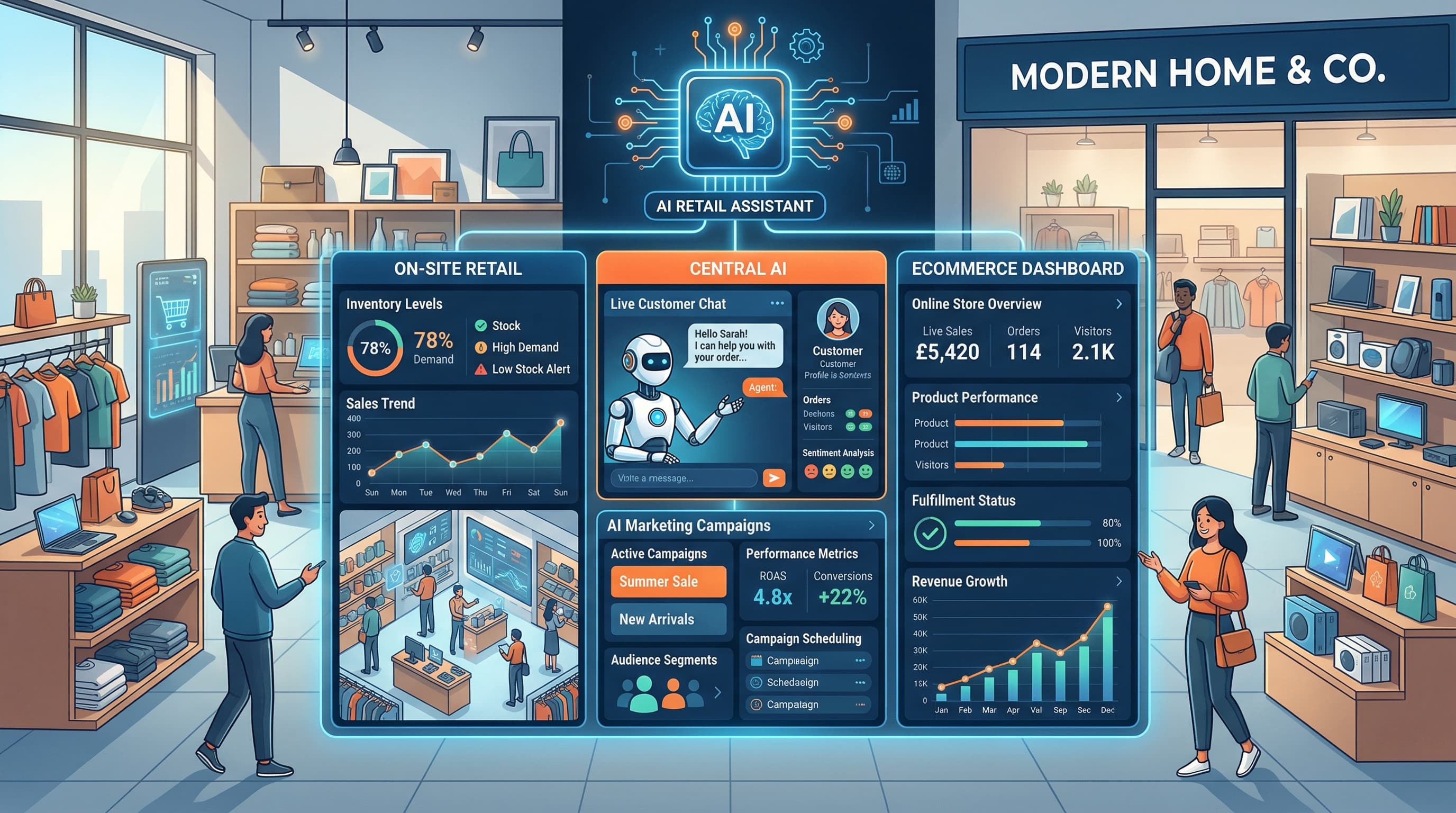
Stock management is one of the biggest headaches in retail. Too much stock ties up cash and leads to markdowns. Too little means lost sales and disappointed customers. Getting it right requires analysing historical sales data, seasonal patterns, promotional calendars, supplier lead times, and a dozen other variables.
AI powered demand forecasting analyses all of these factors and produces stock recommendations that are significantly more accurate than manual planning. It identifies patterns that humans miss: the correlation between weather forecasts and specific product categories, the impact of local events on store traffic, the relationship between social media activity and product demand.
For a UK retailer managing 500 to 5,000 SKUs, AI demand forecasting can typically reduce stockouts by 25% to 40% and overstock by 20% to 30%. In concrete terms, a business turning over £2 million per year that reduces dead stock by 25% could free up £50,000 to £100,000 in working capital.
Automated reordering takes this further. When stock levels hit the AI calculated reorder point, purchase orders are generated and sent to suppliers automatically. The system adjusts reorder quantities based on current demand trends, upcoming promotions, and supplier delivery schedules. Your team reviews and approves rather than manually calculating and creating every order.
Customer Service
Ecommerce customer service follows predictable patterns. Where is my order? How do I return this? Is this in stock? What size should I get? These questions make up 60% to 80% of all customer contacts for most online retailers.
An AI agent integrated with your ecommerce platform can handle these queries automatically. It checks the actual order status in your system (not a generic "your order is being processed" response), initiates returns and generates labels, checks real time stock levels across all warehouses or stores, and provides sizing recommendations based on product data and customer history.
A customer service agent can answer routine delivery and returns questions, then pass exceptions to a person with the conversation context. Track resolution quality, escalation rates, handling time and total running costs before deciding whether the system is delivering value.
Faster replies are only useful if they resolve the customer’s issue. Measure response time, resolution accuracy and customer satisfaction together, and provide a clear route to a person when needed. For a deeper dive into AI customer service options, from basic chatbots to full agents, read our guide on AI for customer service.
Marketing Personalisation
Personalised marketing drives significantly higher conversion rates than generic campaigns. But creating truly personalised content at scale requires either a large marketing team or AI.
AI marketing automation can segment your customer base based on purchase history, browsing behaviour, and engagement patterns, then generate personalised email campaigns for each segment. Not just "Hi [First Name]" personalisation, but genuinely tailored content: product recommendations based on their purchase history, complementary products they might like, restock reminders for consumables they have bought before, and relevant content based on their interests.
For social media and paid advertising, AI can generate and test multiple ad variations, analyse performance, and allocate budget to the best performing versions. What used to require a marketing manager spending hours on A/B testing now happens automatically and continuously.
Product descriptions are another area where AI delivers immediate value. If you are adding new products regularly, AI can generate consistent, SEO optimised descriptions from product specifications and images. A retailer adding 50 new products per week who used to spend 15 minutes per description now spends 2 minutes reviewing an AI generated draft. That is over 10 hours per week saved.
Price Optimisation
Dynamic pricing is standard practice for large retailers but has traditionally been out of reach for SMEs. AI makes it accessible. Pricing algorithms can analyse competitor prices, demand patterns, stock levels, and margin targets to recommend optimal pricing across your product range.
This does not mean changing prices every five minutes like an airline. For most UK retailers, it means reviewing and adjusting prices weekly or bi weekly based on market conditions, with the AI doing the analysis and making recommendations rather than someone manually checking competitor websites.
Practical Implementation
The right starting point depends on where the pain is in your business.
If customer service costs are your biggest concern: Start with an AI customer service agent. This typically delivers the fastest ROI and is relatively straightforward to implement if you are on a modern ecommerce platform (Shopify, WooCommerce, Magento, BigCommerce).
If stock management is the issue: Start with demand forecasting and automated reordering. This requires clean historical sales data (at least 12 months, ideally 24), so factor in a data cleaning phase.
If marketing is underperforming: Start with email personalisation and product description automation. These are relatively quick wins that demonstrate the value of AI before committing to larger projects.
What It Costs
AI customer service: £5,000 to £10,000 for setup, integrating with your ecommerce platform and order management system. Monthly costs of £150 to £400 depending on query volume.
Demand forecasting and automated reordering: £6,000 to £12,000 for setup, depending on the number of SKUs and complexity of your supply chain. Monthly costs of £100 to £300.
Marketing personalisation: £4,000 to £8,000 for setup, connecting to your email platform and ecommerce data. Monthly costs of £100 to £250.
Product description automation: £2,000 to £4,000 for setup. Monthly costs of £50 to £150.
Check our pricing page for detailed breakdowns of retail and ecommerce automation packages.
Getting Started
The UK retail landscape is only getting more competitive. Businesses that adopt AI automation now will have a significant advantage in efficiency, customer experience, and cost management over those that wait.
At Elevate AI, we build automation solutions specifically for UK retailers and ecommerce businesses as part of our automation services. We work with all major ecommerce platforms and understand the specific challenges of multi channel retail.
To discuss your business priorities, explore our AI Consulting engagement or book a free scoping call. The call establishes fit and scope. Detailed discovery, opportunity analysis and a costed roadmap are paid deliverables; implementation is agreed separately.
Related reading: AI automation for logistics and supply chain.